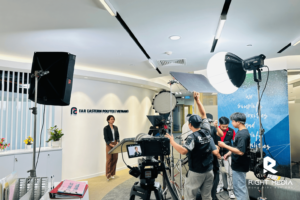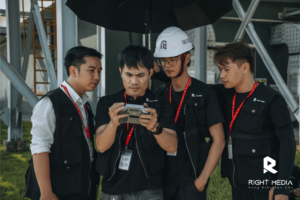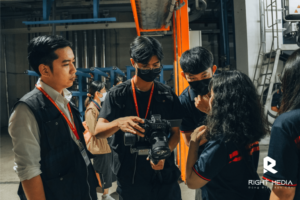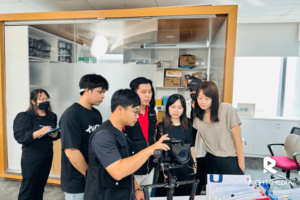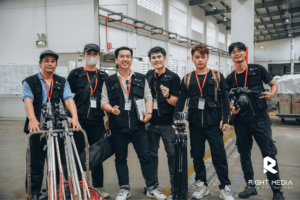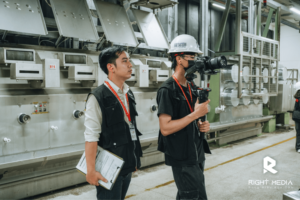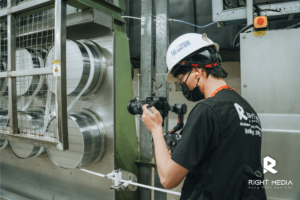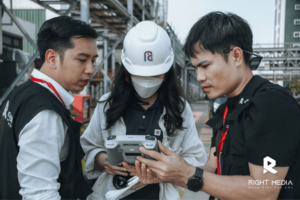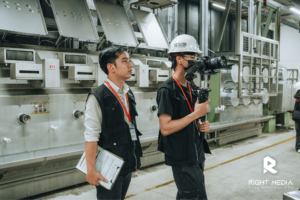
Event livestreaming services utilize multiple cameras, a video mixer, and backup connections—a far different approach from simply setting up a phone on a tripod. Right Media offers livestreaming services for conferences, product launches, signing ceremonies, and internal events, broadcasting simultaneously to Facebook, YouTube, and online meeting rooms, while also recording high-quality footage for post-event compilation videos.
What does a live stream event include?
- 2–4 cameras: A wide-angle camera capturing the stage, a close-up camera of the speaker, a camera capturing audience reactions, and depending on the scale, a dedicated slide camera.
- Mixing console: The director directs live scene transitions, inserts presentation slides, and adds speaker names and video clips according to the script.
- Audio is taken directly from the mixer: The sound is clean and free from the echo that often occurs when recording with a camera microphone.
- Backup connection: Wired internet combined with a backup 4G router, which automatically switches when the main line drops.
- High-quality recording: It is saved in parallel with the stream to create a recap after the event.
Why do livestream events often fail midway?
Three factors account for almost all incidents, and all three can be addressed through the initial survey phase.
The auditorium's internet connection is not sufficient. The hotel's Wi-Fi, shared among hundreds of people, would likely not have enough bandwidth to handle the video feed. The team surveyed the area beforehand, requested a dedicated line, and always carried a backup 4G router.
Echoing sound. Recording with a microphone attached to the camera will mix in the hall's echoes and audience voices. The correct way is to take the signal directly from the sound company's mixer.
No one is monitoring the stream. Someone needs to monitor comments and stream quality throughout the event to address any issues immediately, rather than discovering them after the event has ended.
Implementation process
- Site survey: Check the internet connection, equipment placement, power supply, and coordinate with the sound and lighting crew.
- Final broadcast script: The order of the program, when to insert slides, and when to insert videos.
- Installation and commissioning: Set up the equipment and conduct a test run at least two hours before the opening ceremony.
- Live stream: A video director is on duty at the mixing console, and a technician is on duty for streaming and transmission.
- Hand over: Links to the broadcast, original recordings, and short recaps are available upon request.
Cost of livestreaming an event
Costs depend on the number of cameras, the number of platforms broadcasting simultaneously, and the length of the program. A half-day event with two cameras is considered basic; full-day conferences with multiple rooms or requiring interpretation will be more expensive. See Right Media's service price list to estimate.
Related articles and services
- Corporate event videography services – when a fully edited video is needed instead of a live stream.
- Video recap of the event
- Corporate video production price list
Frequently Asked Questions about Event Livestreaming Services
A dedicated wired internet connection is required for the crew; they will not share Wi-Fi with guests. A minimum upload speed of approximately 10 Mbps is required for a Full HD stream; stability is more important than high speed. Right Media always carries a backup 4G router that automatically switches to a different connection if the main line fails.
Yes. A stream can be simultaneously pushed to the Facebook fan page, YouTube channel, company website, and online meeting room. Each platform receives the same content, so no additional team is needed; clients only need to grant access to the channels before the event date.
Yes. The team records a high-quality version simultaneously at the camera, regardless of the streaming quality. This version is used to create video recaps, edit key speeches, or as internal media material after the event.