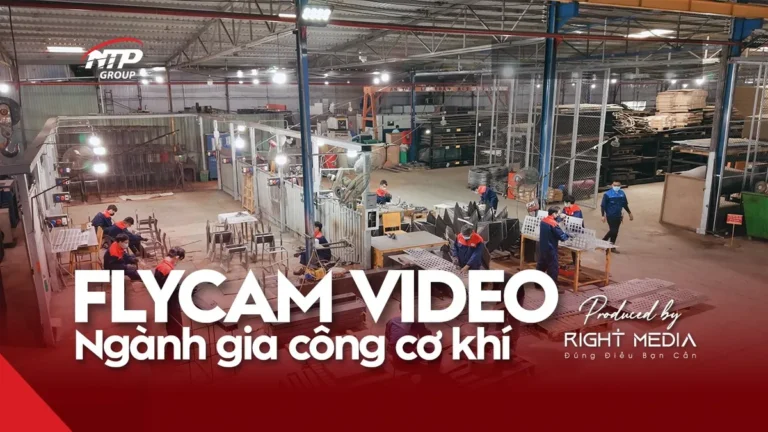
Bilingual Vietnamese-Japanese profile video project for Viet Nhat Precision Engineering Company.
Bilingual profile videos are a popular choice for businesses serving international clients when a single video isn't sufficient for both groups. In this project, Right Media produced two versions, one in Vietnamese and one in Japanese, for Viet Nhat Precision Engineering Company, to be shown at exhibitions and presented to clients before important meetings.
| Client | Viet Nhat Precision Engineering Company |
|---|---|
| Branch | Precision engineering |
| Category | Bilingual profile video |
| Delivery version | Vietnamese and Japanese |
| Purpose of use | Screened at exhibitions, presented before meetings. |
| Production unit | Right Media – Ho Chi Minh City |
Why are two versions needed instead of one with subtitles?
For Japanese audiences, subtitles and commentary are two completely different experiences. In a live meeting, viewers usually listen and discuss simultaneously, so having to read subtitles would cause them to miss the visuals. A version with Japanese commentary solves this problem.
Furthermore, a bilingual video profile differs not only in its audio quality. The order of emphasis also differs: the Vietnamese version focuses on scale and team, while the Japanese version prioritizes quality control and manufacturing precision – precisely what the Japanese purchasing department examines most closely.
Project overview: two film use scenarios
- Screened at the exhibition: The film looped at the booth, often without sound due to the noise. The edited version therefore had to be readable through images and text, independent of dialogue.
- Open before the meeting: The video serves as an introduction, allowing both sides to get straight to the main topic without wasting time reiterating their company's capabilities.
These two scenarios require two different cuts in terms of length, so the film's release location had to be determined in advance during the scriptwriting process.
What needs to be showcased in a bilingual video profile for the mechanical engineering field.
In the precision engineering industry, viewers aren't looking for grandiose factory displays, but rather evidence of precision. Three key areas determine trust: a running CNC machine, a testing room with tolerance inspection procedures, and a quality record system traceable by batch.
Close-up shots of the workpiece surface are more important than wide shots. This is why most of the filming time is dedicated to macro lenses and close-up shots, rather than outdoor drone footage.
Notes when creating a bilingual video profile
Three things should be finalized right from the scriptwriting stage to avoid reshoots. First, agree on technical terminology with the client before translation, as each company has its own way of referring to the same process. Second, leave ample space in the frame for text in both languages, as sentence lengths can vary significantly. Third, anticipate that Japanese voiceovers are usually longer than Vietnamese, so the editing pace should be more relaxed.
The process of producing a bilingual video profile.
Creating two versions isn't simply a matter of translating the commentary at the final stage. The second language must be considered from the scriptwriting phase; otherwise, the post-production team will have to re-edit everything.
- Original script in Vietnamese. Write and review this beforehand, as it determines the structure and duration of each scene.
- Glossary. List any industry-specific terms and company terminology, and send the list to the client for approval before translation.
- Translation and editing. The proofreader should be knowledgeable about the industry, because a translation that is literally accurate doesn't necessarily reflect the professional terminology.
- Group filming. Both versions use the same spin, which accounts for the majority of the cost, so it's not doubled.
- Create the original version. Complete the Vietnamese version first, including color correction and graphics.
- Separate the layers and create a duplicate version. Replace the commentary, change the text, and adjust the pacing to match the sentence length of the second language.
The final step is where most of the work is done. Japanese sentences are often longer than Vietnamese ones, so some scenes have to be extended by a few seconds, which requires adjusting the entire pacing afterward.
The most difficult problem: rotating in a precision machining workshop.
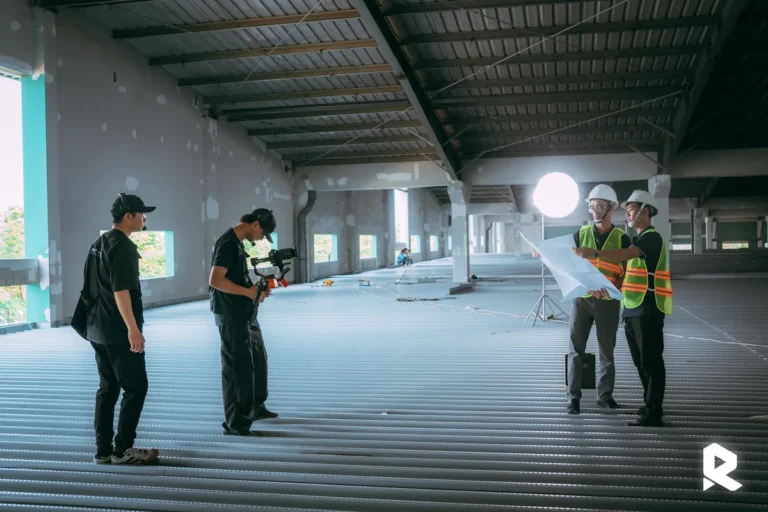
Three specific problems commonly encountered when shooting bilingual profile videos at a precision machining workshop.
Vibrate. The CNC machine is running, transmitting vibrations through the floor and blurring the footage filmed with a tripod. The solution is to use a gimbal in the vibrating areas, or choose a moment when a nearby machine is temporarily paused.
Reflection on metal. The machined surface and the camera housing reflect both the crew and the lights into the frame. The light must be diffused through a large light box positioned off-axis, not shining directly.
Coolant solution. CNC machine rooms are often airtight and filled with vapor, causing lenses to fog up very quickly. Scenes inside the machine room should be filmed through a clean glass door or using a small, fixed camera.
Furthermore, a large portion of the filming time is dedicated to close-up shots using a macro lens. This is a key difference from typical studio films, which prioritize wide shots.
Cost and time required to create a bilingual video profile.
A bilingual video profile doesn't cost twice as much. The video recording, which makes up the largest portion, is shared between both versions. The additional cost is in three areas: translation and editing, recording commentary in the second language, and re-editing the text and synchronization of the cuts.
In terms of time, the original version typically takes three to four weeks from the initial idea approval. The second language version adds about a week, mainly for the client's review of the translation. If the film needs to be ready for an exhibition, the completion date should be pushed back at least a week before the opening to allow time to address any terminology issues.
Related articles and services
- Corporate video production services
- Video introducing the precision engineering factory.
- Voiceover and narration services
Frequently Asked Questions
No. The footage is shared between both versions, so there are no additional costs; the only extra expenses are translation, recording second-language voiceovers, and re-editing the text. The increase is usually much smaller than organizing a separate filming session for each language.
It depends on the screening location. Films shown in meetings should be dubbed, as viewers will be listening and discussing simultaneously, and reading subtitles would cause them to miss the visuals. Films looping at exhibition booths are more suitable with subtitles, given the noisy environment and the fact that visitors usually don't stay long enough.
The best way to prevent this is to send a glossary of terms to the client for approval before recording the commentary, as each company has its own terminology for the same process. If an error is discovered after editing, the correction only requires re-recording that particular phrase and replacing the text, rather than re-editing the entire film.