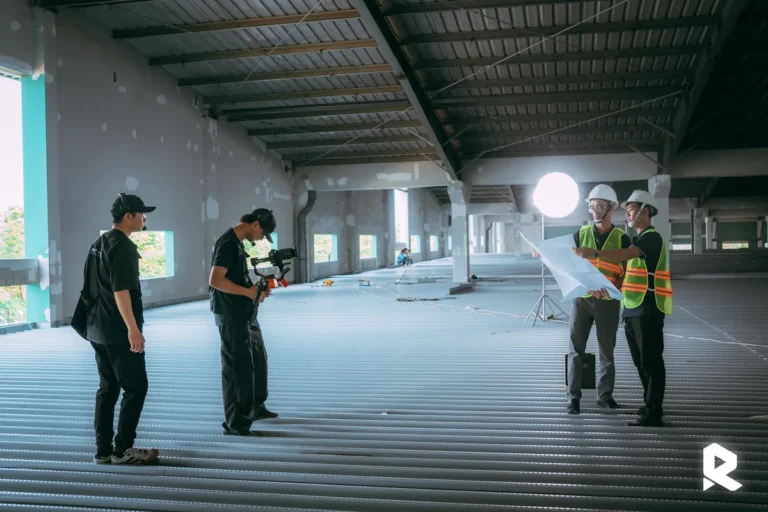
Flycam video project of NTP Group's mechanical factory.
A drone video of a mechanical factory solves a problem that ground-based camera angles can't: showing viewers the true scale of the factory in a single drone video. In this project, Right Media filmed a panoramic view of NTP Group's mechanical processing factory using a drone, combined with footage of the factory's operations and a meeting with foreign partners taking place at the same time.
| Client | NTP Group |
|---|---|
| Branch | Mechanical machining |
| Category | Flycam video of the mechanical factory. |
| Video content | Overview of the factory, workshop operations, meeting with foreign partners. |
| Filming location | NTP Group Mechanical Processing Factory |
| Production unit | Right Media – Ho Chi Minh City |
Why should you make drone videos of a mechanical factory?
Customers of a machining workshop typically place orders based on drawings and need to know three things before signing a contract: the size of the workshop, the number of machines running, and how goods enter and exit the premises. All three are difficult to convey verbally or through photographs of the floor plan.
A flycam shot from the gate offering a panoramic view of the factory answers all three questions in seconds. This is why flycam videos of mechanical factories are often placed at the beginning of capability videos, before going into detail about each process.
Project overview: what has been documented
- A panoramic view of the factory taken by drone. – site size, factory layout, and surrounding infrastructure.
- Production space – the processing area, machinery, and material flow within the workshop.
- Operations team – scenes of people working, an element that prevents the factory from being seen as a soulless mass of machinery.
- Meeting with foreign partners – Specific details of this project, showing that the factory is working with international clients.
The most challenging aspect of shooting drone videos of a mechanical factory.
Flying a drone in an industrial park isn't a decision made on the spot. Three things have to be done before filming day:
- Requesting permission to fly – Most industrial zones require advance flight registration along with a list of personnel and equipment; areas near airports require separate procedures.
- Flight path survey – Identify overhead obstructions, obstacles inside the workshop, power lines, and factory areas where filming is prohibited.
- Airfield within the factory – The speed, distance, and flight path within the factory require an experienced "flycam pilot" to avoid disrupting the overall factory operation while still attracting viewers.
Furthermore, the flight time directly affects image quality. Oblique light in the early morning or late afternoon accentuates the factory buildings, while midday sun causes the corrugated iron roofs to overexpose and lose detail.
What scenes are included in a drone video of a mechanical factory?
The aerial shots in a drone video of a mechanical factory can't be random. An effective edit usually follows five groups of shots, arranged from wide to narrow.
- Approach scene. Fly in from the outside, capturing the gate, sign, and the road in front of the factory. This scene answers the question of where the factory is located and what the size of the site is.
- Panoramic view. Flying high, it encompasses the entire site including factories, warehouses, and loading/unloading areas.
- Close-up shot. The aircraft approached a specific area while the CNC machines and personnel continued to operate.
- Topshot scene. Perpendicular to the operating machine. This unique perspective allows viewers to better understand the production line and coordination than other camera angles can.
- The scene depicts an exchange. The corner where the engineering team exchanged views with their client, Audit Corporation, demonstrates the professionalism of the team and staff.
What's remarkable is that this video doesn't use a ground-based camera, yet it still clearly shows close-ups of modern machinery, equipment, and people at work. To achieve this, in addition to skilled personnel and equipment, the camera lens must be professional and capable of capturing close-ups without losing focus.
Equipment and flight configuration for drone video in a mechanical factory.
In industrial environments, specifications are more important than the price of the machine.
Outdoor Use a medium-sized drone and shoot at high resolution to leave room for cropping and image stabilization. Keep the flight speed slow, as industrial scenes require a sense of stability rather than rapid movements.
In the factory Using a small drone with a protective cage, fly low and slowly along the walkways between the machinery. The flight path must be surveyed beforehand to avoid hanging objects, wires, and hot air rising from the machinery.
Besides drones, factory projects often require gimbals for ground movement shots and telephoto lenses for close-up shots of machining details. These three sets of equipment complement each other, not replace each other. For NTP Group's project, due to its urgency and low expectations, Right Media suggested that only one drone would be sufficient for the entire factory.
Costs and common associated items
For drone video of a mechanical factory, the cost depends on four factors: the number of flight sessions, whether indoor flights are required, the permit application process in restricted areas, and the amount of post-production work such as color correction, graphic adjustments, or creating multiple versions.
One point businesses should clarify when receiving a quote is the contingency day. Weather is a constant risk to flights, so the contract should clearly state whether delays due to strong winds or rain incur additional costs. Companies that handle many industrial projects usually include a contingency day in their package.
In addition to the main video, the accompanying items often include aerial photographs for company profiles and websites, and vertical-scale cropped versions for social media. Both are taken from the same flight, so the additional cost is negligible.
Related articles and services
- Flycam filming and aerial photography services.
- Filming a promotional video for a mechanical manufacturing workshop.
- Factory video production services in Ho Chi Minh City.
Frequently Asked Questions
A standalone video is usually 2–3 minutes long, enough to go from a wide shot to detailed shots without repetition. If the drone footage is just part of a corporate film, the flight time usually only takes up 20–40 seconds at the beginning and end, as watching too many aerial shots can become monotonous.
Yes, with a small drone with a protective cage, it can be used to capture a panoramic view of the production line that ground-based cameras can't cover. The condition is that the factory agrees and the flight path is free of obstructions or strong hot air currents, so a survey is necessary beforehand; a decision cannot be made on the spot.
It depends on the service package. With basic packages, drones are usually an extra charge because they require separate equipment and a pilot. With professional packages and above, drones are included in the scope of work. It's important to ask before signing the contract who will be responsible for the flight permit application fee.